
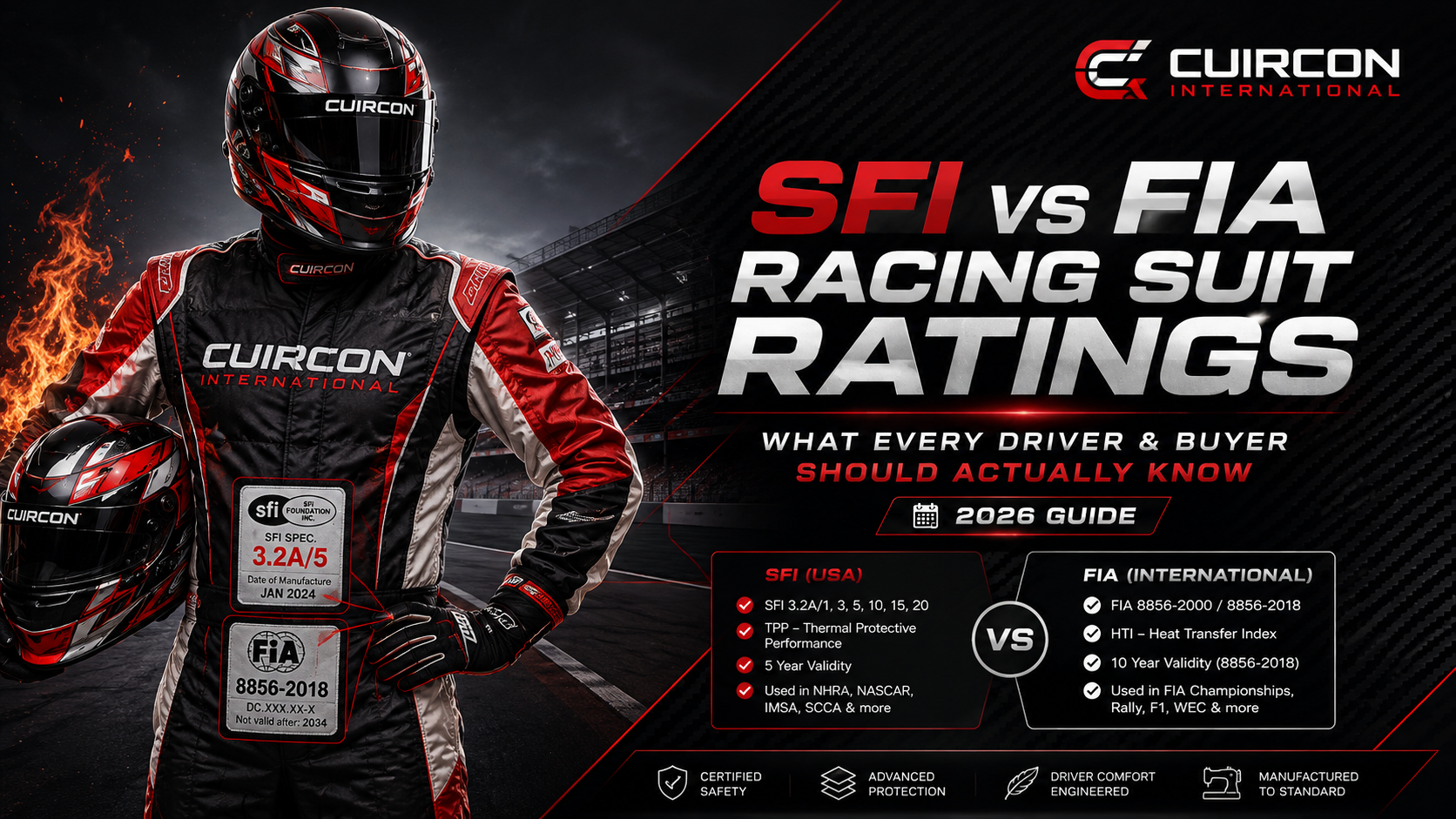
There are two sets of numbers on almost every fire-resistant race suit sold today, and most drivers buying their first suit have no idea what either of them means. One label says something like SFI 3.2A/5. Another says FIA 8856-2018. They are not interchangeable, they are not tested the same way, and buying the wrong one can mean being turned away at scrutineering on race morning.
After three decades of manufacturing racewear for brands across the United States, United Kingdom, Canada and Europe, we field this question constantly — from drivers, from track owners, and from the brands we produce for. Here is the plain-English version.
Why fire ratings exist at all
A racing suit is not fireproof. Nothing is. What a certified suit does is buy you time — the seconds between a fuel fire starting and a marshal reaching you. Every rating system is essentially a measurement of that time.
The materials do the work. Meta-aramid fibres (Nomex is the best-known brand name) do not melt or drip; they carbonise and form an insulating barrier. Multi-layer construction traps air between layers, and that trapped air is what slows heat transfer to your skin. This is why a two-layer suit dramatically outperforms a single-layer suit, even when both look identical from the outside.
SFI ratings explained: the 3.2A scale
The SFI Foundation is a US non-profit that issues specifications used by NHRA, NASCAR, IMSA, SCCA, dirt track sanctioning bodies and most American club racing. Driver suits fall under SFI Spec 3.2A.
The number after the slash is the important one. It comes from a Thermal Protective Performance (TPP) test, and the rule of thumb is simple:
Seconds before second-degree burn ≈ TPP value ÷ 2
| Rating | TPP value | Approx. protection time | Typical construction |
|---|---|---|---|
| SFI 3.2A/1 | 6 | ~3 seconds | Single layer |
| SFI 3.2A/3 | 14 | ~7 seconds | Single layer, heavier / two layer |
| SFI 3.2A/5 | 19 | ~10 seconds | Two to three layer |
| SFI 3.2A/10 | 38 | ~19 seconds | Multi-layer |
| SFI 3.2A/15 | 60 | ~30 seconds | Multi-layer, top fuel category |
| SFI 3.2A/20 | 80 | ~40 seconds | Multi-layer, nitro classes |
A 3.2A/1 suit gives you roughly three seconds. That is enough for a road-course incident where you can get out of the car quickly. It is nowhere near enough for a methanol or nitro fire, which is why drag racing escalates the requirement as elapsed times drop.
Two things people get wrong about SFI:
- SFI certification expires. Most driver suits carry a five-year validity from the date of manufacture, tracked by the label. An out-of-date label fails tech inspection even if the suit looks brand new.
- The rating covers the garment as a system. Thread, zips, cuffs and the collar are all tested. This is why a professionally re-tailored suit is fine and a suit repaired with ordinary polyester thread is not — polyester melts.
FIA ratings explained: 8856-2000 and 8856-2018
The FIA is the international governing body, and its standard is used across European and international competition — rallying, GT, single-seaters, and anything running under an FIA sanction.
FIA 8856-2018 is a 50-page set of safety standards that replaced the earlier FIA 8856-2000 regulation, and it applies to all fire-retardant clothing including suits, underwear, boots and gloves. It took effect from 1 January 2022, from which point new racewear could no longer be manufactured to the older 8856-2000 homologation.
The main changes worth knowing:
- Roughly 20% more heat transmission protection than the previous standard, measured using the Heat Transfer Index (HTI) rather than TPP.
- An expiry date printed on the label for the first time — a 10-year lifespan from the date of manufacture.
- Testing extended beyond fabric to seams, thread, zips and structural tensile strength.
- A gold hologram on 8856-2018 labels, versus silver on 8856-2000.
Older 8856-2000 racewear remains usable in many national-level events, and Motorsport UK in particular allows continued use of equipment after FIA homologation expiry — but from 1 January 2029 the 8856-2000 standard becomes obsolete for FIA-sanctioned competition. If you compete internationally and your suit is 8856-2000, you have a replacement deadline in your calendar.
SFI vs FIA: which one do you actually need?
Neither standard is “better.” They are built for different regulatory worlds.
Choose SFI if you race in North America. Drag racing, oval, dirt, SCCA club events and most US track-day organisers work from SFI specs. FIA-only gear is frequently not accepted, because tech officials are checking against a rulebook written around SFI numbers.
Choose FIA if you race in Europe or in any FIA-sanctioned series. An SFI-only suit will usually not pass scrutineering at an FIA event.
Choose dual-certified if you travel. Some suits carry both labels. They cost more and generally weigh more, but they remove the problem entirely.
The only answer that always works: read your series rulebook for the current season. Requirements change, and they vary by class within the same sanctioning body — drag racing in particular scales the required rating to elapsed time and to whether the car runs a supercharger or alcohol.
What about karting and rental karts?
This is where a lot of confusion lives. Most kart racing does not require a fire-rated suit at all. CIK-FIA level 2 karting suits are certified for abrasion resistance, not fire — the risk profile in a kart is road rash, not a fuel fire.
Rental and arrive-and-drive karting is different again: venues typically need durable, washable, comfortable suits that survive hundreds of cycles through an industrial laundry. Spending money on fire certification you do not need is one of the most common budgeting mistakes we see from new track operators.
How to read a race suit label in 30 seconds
- Find the certification tag — usually inside the collar or on the inner waistband.
- Check the standard and number — SFI 3.2A/x, or FIA 8856-2018 / 8856-2000.
- Check the date. SFI suits carry a manufacture date with a five-year window. FIA 8856-2018 suits state a “not valid after” date directly.
- Check the hologram on FIA gear — gold for 2018, silver for 2000.
- Verify the manufacturer. SFI publishes a searchable list of certified manufacturers on its website. If a supplier claims certification, you should be able to find them there.
That last point matters more than it sounds. Certification is issued to a manufacturer for a specific construction, not to a label printed on a tag. A supplier who cannot be found in the official register is not certified, whatever the tag says.
Frequently asked questions
Can I wash a fire-resistant race suit? Yes. The FR properties of meta-aramid are inherent to the fibre, not a coating, so washing does not remove them. Use mild detergent, no bleach, no fabric softener — softener leaves a flammable residue on the fabric. Air dry.
Does a suit’s rating drop as it ages? The fibre does not lose its properties, but the suit does. Abrasion, oil and fuel contamination, seam wear and repeated laundering all degrade real-world performance. This is exactly why both bodies impose expiry dates.
Do I need fire-resistant underwear? For entry-level SFI 3.2A/1 and /3 suits, FR underwear meaningfully increases total protection and is required by several sanctioning bodies. For higher-rated multi-layer suits it is often mandated outright. Check your rulebook.
Does a higher rating mean a better suit? Only if you need it. Higher ratings mean more layers, more weight and more heat retention for the driver. A road racer in a 3.2A/20 suit is carrying weight and heat stress for protection the discipline does not call for.
Manufacturing to standard: how Cuircon works
Cuircon International has manufactured motorsport and racewear apparel for over 30 years, supplying brands across the US, UK, Canada and Europe from our facility in Sialkot, Pakistan.
We hold SFI certification for our fire-resistant products — verifiable directly on the SFI Foundation’s register. Our range covers auto racing, kart racing and rental kart apparel: suits, gloves, shoes, balaclavas, jackets and accessories, with in-house sublimation printing, private label and fully custom manufacturing down to a single driver’s suit. We ship FOB from Karachi.
If you are a brand, a race team, a club or a kart track and you want gear built to the right standard for your discipline — not a standard higher than you need, and never lower — get in touch with our team.
Standards and rulebooks change. This article is a general guide; always confirm requirements against your sanctioning body’s current regulations before purchasing.