
SFI 3.2A & 3.4 Update: Why Wrist and Ankle Cuffs Are Mandatory in Driver Suits
Educating the Racing Community on Safety, Compliance, and Certification
In motorsports, safety is never optional. Recently, SFI Foundation Inc. reinforced an important requirement within SFI 3.2A and SFI 3.4 driver suit specifications—a requirement that has existed for decades but is now being strictly enforced.
At Cuircon International, we believe it is our responsibility not only to manufacture SFI-compliant racewear, but also to educate our customers so they can avoid certification issues and ensure maximum driver protection.
This article explains what has changed, why it matters, and how it affects your next SFI-certified suit.
What Is the Latest SFI Clarification?
SFI has officially confirmed that:
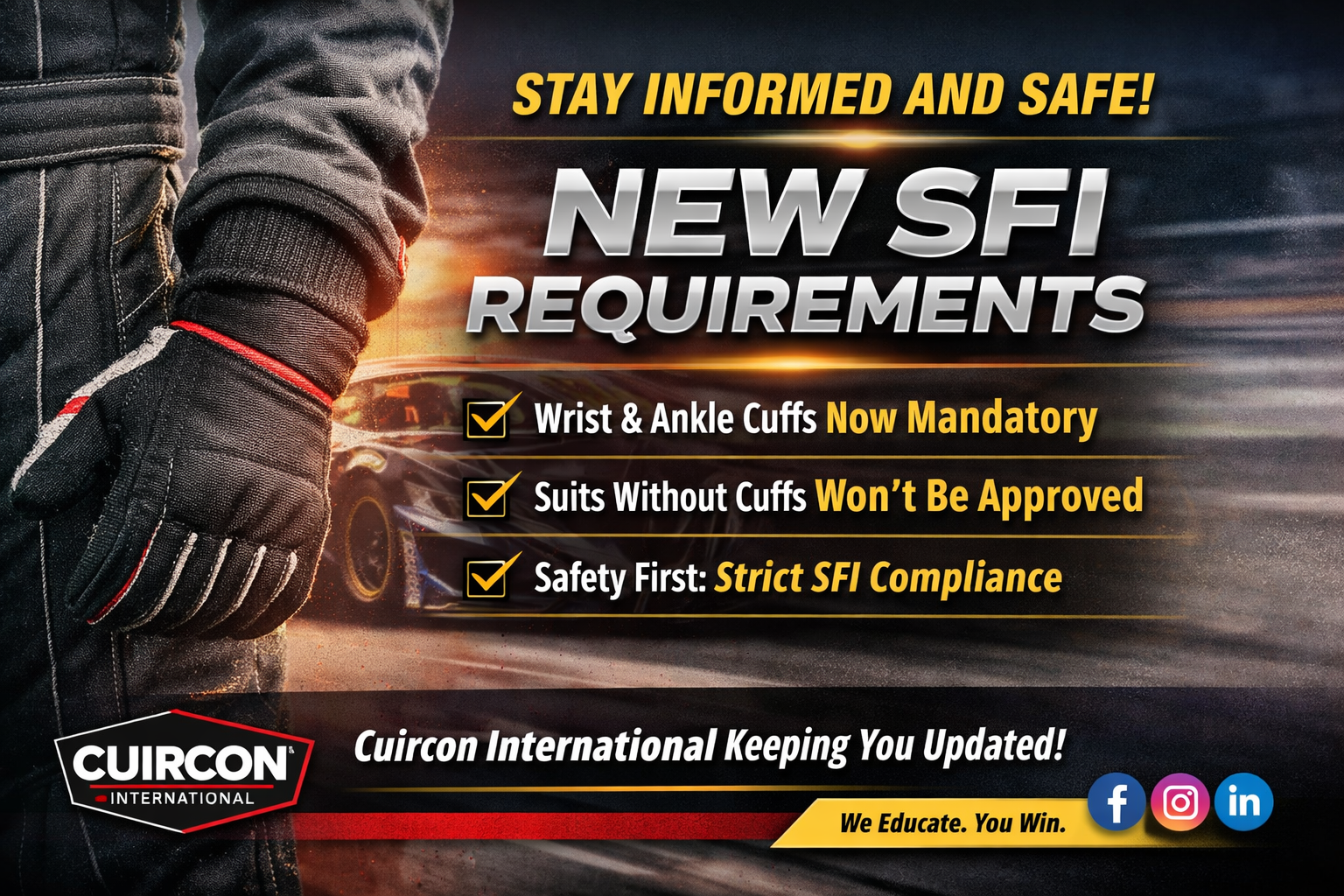
- Wrist cuffs and ankle cuffs are mandatory for all SFI 3.2A and SFI 3.4 driver suits
- Suit models without cuffs will not be approved
- Test reports without cuff testing will be rejected
- This applies to all new certifications and validations
While this requirement has always existed in the SFI specifications, SFI has now clearly stated that non-compliant designs will no longer be accepted, regardless of styling or brand.
Where Is This Written in the SFI Specifications?
The cuff requirement is clearly defined in multiple sections of the SFI standards, including:
- Section 2.1
- Section 5.2.2
- Section 6.1.2
In these sections, cuffs are specifically identified as:
- Wrist cuffs (arms)
- Ankle cuffs (legs)
This means cuffs are not a design preference — they are a technical safety requirement.
Why Are Wrist and Ankle Cuffs So Important?
🔥 1. Fire and Heat Protection
Cuffs create a tight seal at the wrists and ankles, reducing the risk of:
- Fire intrusion
- Heat penetration
- Exposure during high-temperature incidents
Without cuffs, openings between gloves, shoes, and the suit can allow flames or hot gases to enter.
🛡️ 2. Proven Safety Practice
SFI has emphasized that cuffs have been part of over 40 years of accepted driver suit construction. Removing them introduces unnecessary and avoidable safety risks.
📋 3. Certification Integrity
SFI certification is only valid when:
- The entire suit design, including cuffs, is tested
- All required areas meet thermal protection standards
A suit without cuffs — or without cuff testing — cannot be validated, no matter how good the rest of the suit is.
Can Cuffs Be Hidden for Design Purposes?
Yes — and this is an important point for teams and brands focused on styling.
SFI allows cuffs to be:
- Covered
- Integrated
- Hidden (for example, boot-cut leg designs)
However:
👉 The cuffs must physically exist and function at the wrists and ankles
Design freedom is allowed — removal is not.
What This Means for Race Teams, Brands, and Distributors
If you are:
- Developing new SFI-certified suits
- Updating an existing suit design
- Switching manufacturers
- Ordering private-label racewear
You must ensure that:
- Wrist and ankle cuffs are included
- Cuffs are made from approved FR materials
- Cuffs are included in SFI testing and documentation
Ignoring this can lead to:
❌ Certification delays
❌ Rejected test reports
❌ Lost time and increased costs
How Cuircon International Supports You
At Cuircon International, we stay closely aligned with:
- SFI specification updates
- Certification requirements
- Best practices in racewear safety
We don’t just manufacture — we guide our customers through:
- SFI-compliant design development
- Proper cuff integration
- Testing and certification readiness
- Future-proof racewear solutions
Our goal is simple:
No surprises. No rejections. Full compliance from day one.
Final Thoughts
SFI’s clarification is not a new rule — it is a strong reminder that safety fundamentals matter.
Wrist and ankle cuffs are a small detail that make a big difference in:
- Driver safety
- Certification success
- Professional racewear standards
If you’re planning your next SFI 3.2A or 3.4 driver suit, make sure it’s built right the first time.
📩 Contact Cuircon International to discuss SFI-compliant designs, samples, or technical support.